By Theo Brandt · Updated
Encharge vs Customer.io: Pricing and Fit for SaaS (2026)
Customer.io costs less at every volume both vendors publish: Essentials reads $100 at 5,000 profiles and $145 at 10,000, while Encharge reads $179 (Growth) or $269 (Premium) at 5,000 subscribers and $249 or $399 at 10,000. Encharge earns its price when a marketer, not an engineer, owns the flows and your stack is Stripe, Chargebee, HubSpot or Salesforce.
Decision summary
Choose Customer.io if an engineer will send product events and you want push, in-app or SMS later. Essentials is $100 for 5,000 profiles and includes 1 million emails a month, so the plan has room to grow before overages begin.
Choose Encharge if the person building journeys is a marketer who connects Stripe or Chargebee and a CRM, and who wants live chat support on every plan. Count on Premium, not Growth, the moment your own app has to send events.
Check the plan before the product. Encharge Growth leaves out API events, event-based segments, custom objects and transactional email, which is why the cheaper-looking tier often does not do what a SaaS team assumed.
Prices checked 7 October 2026; each price links to the vendor page it came from.
These two are often shortlisted together because both sell behaviour-based email to software companies, and both offer a visual flow editor. Encharge positions itself narrowly for SaaS: its pricing page headline is "Pricing that scales with your SaaS business", and it ships flow templates for onboarding, retention and churn reduction. Customer.io is broader, covering push, in-app messages, SMS and WhatsApp next to email, with a pricing structure that grows through plan tiers instead of a single subscriber ladder.
The comparison is less about the editor than about two questions: where do the events come from, and what plan do you need to receive them? Encharge answers the second question with a tier boundary. Customer.io answers it with profile counts.
| At a glance | Encharge | Customer.io |
|---|---|---|
| Pricing unit | Subscribers, with two self-serve plans and a custom plan above 50,000 | Profiles (people plus objects) on Essentials; Premium is custom |
| Entry price | Growth $99 monthly or $79 billed yearly for 2,000 subscribers; Premium $159 or $129 | Essentials $100 monthly for 5k profiles; Premium from $1,000 billed yearly |
| Email allowance | 10 times subscribers on Growth, 12 times on Premium; overage $100 per 100,000 emails | 1 million a month on Essentials; $0.12 per extra 1,000 |
| Product events via API | Premium only (API events and event-based segmentation) | Included on Essentials |
| Transactional email | Premium only | Included on every plan |
| CRM connectors | HubSpot and Salesforce on Premium; Zapier, Stripe and Chargebee on Growth | Basic data integrations on Essentials, premium integrations from Premium |
| Support | Live chat on both plans; Slack support on Premium | Email and community on Essentials; chat and onboarding from Premium |
| Trial or free offer | 14-day free trial | 12 months free for companies that raised under $10M |
Three list sizes, priced from each vendor's own ladder
Encharge shows a subscriber slider and two plans; Customer.io shows a profile selector on Essentials. The sums below put the plan that can receive API events from your product on both sides, which is Encharge Premium against Customer.io Essentials, and add Encharge Growth for reference.
| Audience | Encharge Growth | Encharge Premium | Customer.io Essentials |
|---|---|---|---|
| 2,000 subscribers | $99 ($79 yearly) | $159 ($129 yearly) | $100 (entry price quotes 5k profiles) |
| 5,000 | $179 | $269 | $100 |
| 10,000 | $249 | $399 | $145 |
| 25,000 | $389 | $649 | Between $235 (20k) and $325 (30k) |
Like for like, at 10,000 people Encharge Premium is $399 against $145, a gap of $254 a month or 12 x $254 = $3,048 a year. At 5,000 the gap is $169 a month. The annual-billing discount narrows Encharge a little: its page says paying yearly saves 20%, and the 2,000-subscriber readouts drop from $99 to $79 and from $159 to $129.
The sums are not entirely symmetrical. Customer.io counts every person and object profile that existed during the billing month, including ones you later delete, and charges $0.009 for each extra profile on Essentials; see its billing documentation. A 5,000-person account that also loads 1,000 companies as objects is a 6,000-profile account. On the other side, Encharge's email allowance is tied to subscribers: at 5,000 subscribers that is 50,000 emails a month on Growth and 60,000 on Premium. A product that sends 150,000 emails to that audience is about 100,000 past the Growth allowance, and the overage note on the pricing page reads "We charge $100 for every 100,000 emails sent", so ask Encharge how it applies that to your volume before assuming it is a flat extra $100.
Customer.io's email allowance works the other way. Essentials bundles 1 million emails regardless of profile count, and sends above that cost $0.12 per 1,000, so 200,000 extra emails would add 200 x $0.12 = $24.
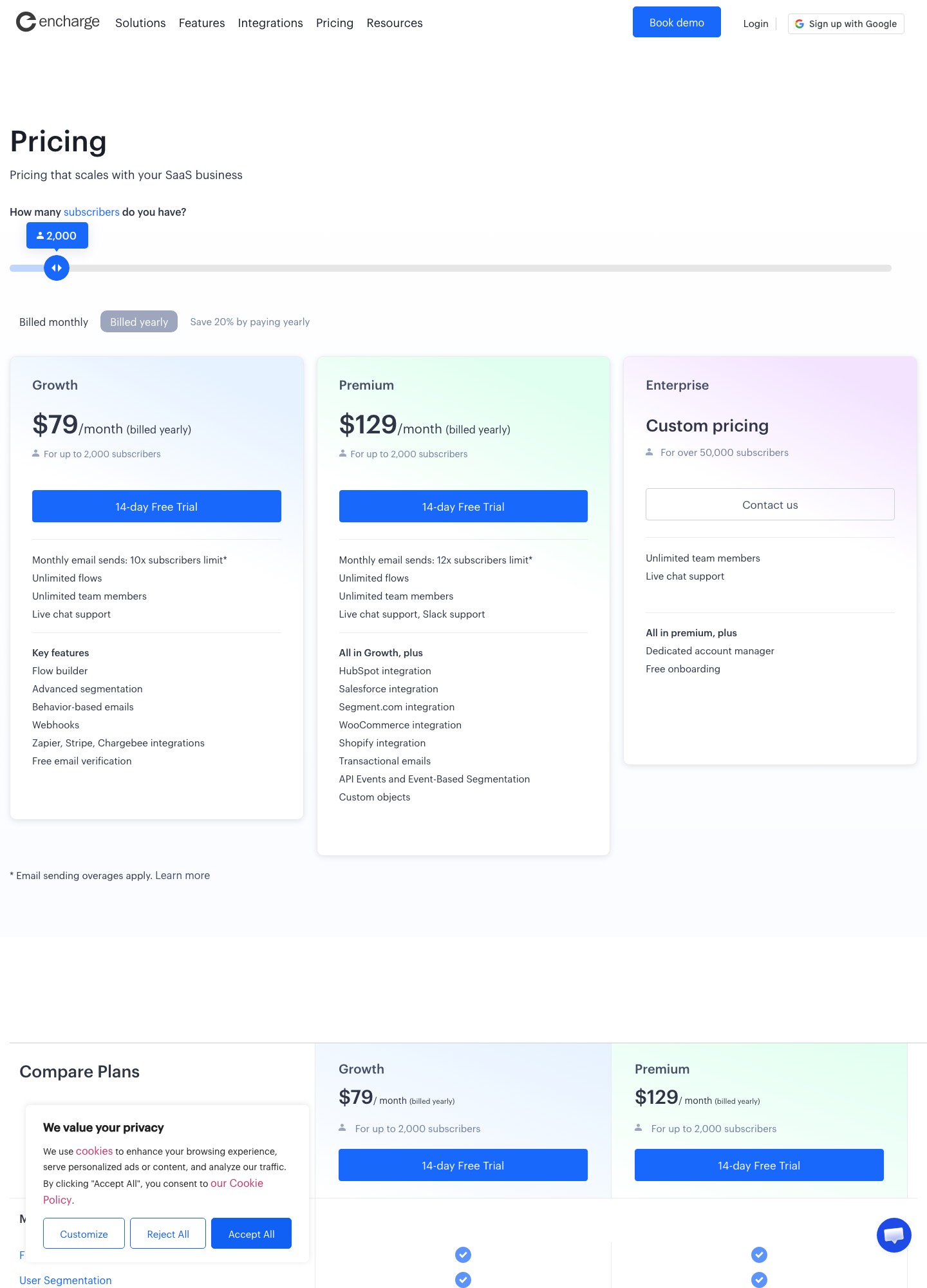
Where Encharge's two plans split
The plan cards on Encharge's pricing page draw a clear line. Growth includes the flow builder, advanced segmentation, behaviour-based emails, webhooks, unlimited flows and team members, free email verification, and Zapier, Stripe and Chargebee integrations. Premium is described as everything in Growth plus HubSpot, Salesforce, Segment, WooCommerce and Shopify integrations, transactional emails, API events with event-based segmentation, and custom objects. The feature table further down flags event-based segments, the company data model and company segments as not available on Growth.
For a software company this splits the field. A team that only needs billing-triggered sequences, such as trial ending or card failing, can get those from Stripe or Chargebee data and a webhook, so Growth works. A team that wants "invited a colleague but has not created a project" has to get that action from its own product, and Encharge only accepts that through API events on Premium. It also decides where password resets go: transactional email is a Premium feature, so Growth users still need a separate sender.
Customer.io Essentials includes the data-in side from the start. Its table lists unlimited webhooks in both directions, reverse ETL, an AI-powered segment builder, send-time optimization and a code editor beside the drag-and-drop one, and transactional emails on every plan. What Essentials leaves out is mostly service: chat support, onboarding support, custom role-based permissions, managed deliverability and anonymous messages are marked as not included, and workspaces are capped at 2.
| Your situation | Better fit | Why |
|---|---|---|
| Marketer owns flows; data comes from Stripe or Chargebee | Encharge Growth | Both billing integrations are on Growth, with live chat support; $99 at 2,000 subscribers |
| App sends its own events such as invited, exported or limit reached | Customer.io | Events arrive on Essentials at $145 for 10k; Encharge needs Premium at $399 |
| HubSpot or Salesforce is the system of record for sales | Encharge Premium | Both connectors are listed on its plan card; the HubSpot route is covered in HubSpot vs Customer.io |
| Push, in-app or WhatsApp alongside email | Customer.io | Push and in-app are listed unlimited and WhatsApp as included; Encharge lists a Twilio SMS integration only |
| Product sends far more than 12 emails per subscriber each month | Customer.io | 1 million bundled emails against an allowance that scales with subscribers |
| No engineer, want someone to answer in chat | Encharge | Live chat on both plans; Customer.io offers chat only from Premium |
Switching in either direction
Encharge to Customer.io: export people with their tags, fields and scores. Encharge leans on tags to drive flows, so decide up front whether each tag becomes a Customer.io attribute, a segment or an event, and write that mapping down before importing. Rebuild each flow as a campaign, and replace Encharge's Stripe and Chargebee triggers with events from those tools or from your own backend. Check which of your HubSpot or Salesforce connectors sit in the Basic or Premium integration set on the Customer.io table, because Essentials lists only basic ones.
Customer.io to Encharge: price the move on Premium, not Growth, if any of your journeys use events, objects or transactional mail. Move one event stream at a time to the Encharge API, keep Customer.io live for one billing cycle with new sign-ups routed to only one of the two tools, and confirm how Encharge's 12x-subscribers email allowance matches your busiest month.
If you are still weighing Encharge itself, the Encharge alternatives guide lists other tools at the same price point, and ActiveCampaign vs Customer.io shows how a marketing-automation suite compares with Customer.io.
Our pick
For a typical product-led SaaS company with an engineer on call, Customer.io wins on price and on data access: cheaper at 5,000, 10,000 and 25,000, with events and transactional mail included. Encharge is the better fit for a marketing-led team with a Stripe or Chargebee billing stack, a CRM that sales lives in, and no spare engineering time, as long as the budget is set on Premium when events matter. Related reading: Customer.io vs Loops for a cheaper, simpler foil, email platforms for B2B SaaS, and the comparison hub.
Frequently asked questions
Is Encharge cheaper than Customer.io?
Not on the readouts both vendors show. Encharge Growth is $179 at 5,000 subscribers and $249 at 10,000; Customer.io Essentials is $100 at 5,000 profiles and $145 at 10,000. Encharge only comes out ahead if its flat, subscriber-based price replaces tools you would otherwise buy next to Customer.io.
Which Encharge plan do I need to send product events?
Premium. The plan card lists API events and event-based segmentation under "All in Growth, plus", and the feature table marks event-based segments as not available on Growth. Premium starts at $159 a month at 2,000 subscribers ($129 billed yearly).
Does Encharge include transactional email?
Only on Premium. Growth is for marketing and behaviour emails. Customer.io lists transactional emails as included on all of its plans, though they count toward the 1 million monthly emails on Essentials.
How does Encharge limit email volume?
By subscribers: 10 times the subscriber limit per month on Growth and 12 times on Premium, so 2,000 subscribers can receive 20,000 or 24,000 emails. Past that, the pricing page states it charges $100 for every 100,000 emails sent.
Does Customer.io Essentials include live chat support?
No. Essentials lists email and community support; chat and onboarding support are marked as included from Premium, which starts at $1,000 a month billed yearly. Encharge gives live chat on Growth and Premium alike.